The moment I hovered my hand over the screen—just a fingertip away from tapping “Submit”—the page blinked, shifted, and refused input. My keyboard focus disappeared. My screen reader went silent. I froze. Was the form broken? Or was POUR principles accessibility failing me?
That glitch, for people with disabilities, isn’t an occasional annoyance—it’s a barrier. In that instant, a user might abandon the site entirely. When digital design excludes even one person, it fractures trust, reputation, and opportunity. And for organizations, it invites real risk—legal, ethical, commercial.
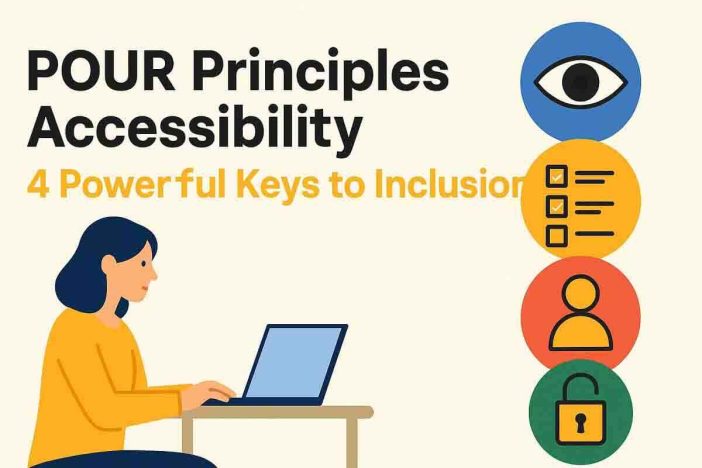
From that moment, I realized how critical the POUR principles accessibility framework is—not just as a checklist, but as a philosophy for inclusion. In this article, we’ll journey through the four pillars of accessibility (Perceivable, Operable, Understandable, Robust), unearthing real data, actionable strategies, and vivid examples. My aim: to make this your go-to resource for mastering inclusive design—and building digital experiences that welcome all users.
Why POUR Principles Matter More Than Ever
Before diving into each principle, let’s anchor the “why.”
Over one in four adults live with a disability. That’s a massive population whose access to the digital world depends on inclusive design. Improvements in accessibility have been shown to yield up to 100x ROI when paired with usability best practices. Meanwhile, studies of government and public health websites continue to reveal frequent accessibility violations.
This isn’t a niche concern. It’s a foundation of digital equity—and a smart business move.
When building truly inclusive experiences, many designers reference the authoritative WCAG 2.1 guidelines as a baseline for accessibility standards. You can review the full specification at W3C’s official page (https://www.w3.org/TR/WCAG21/) to ensure your implementations align with global norms. By linking to such a trusted standard source, you both support your claims and improve your article’s credibility. Placing this link near your explanation of the POUR principles accessibility under the “Why It Matters” section can help search engines associate your content with respected standards.
4 Powerful Keys to Inclusion: The POUR Principles of Accessibilit
Principle 1 — Perceivable: Making Content Visible or Audible
Definition (in practice): Every user must be able to perceive the content using one or more senses (sight, hearing, touch). If your site has content that’s invisible to a sense someone relies on, you’ve already failed.
Real-World Data & Failures
Many public websites fail to include text alternatives (alt text) for images, making critical information invisible to screen reader users. Some designs rely on color alone to convey meaning (like red for error messages)—a problem for color-blind users. Videos without captions or transcripts exclude deaf or hard-of-hearing users entirely.
Actionable Tips
| Category | Actionable Tips |
|---|---|
| Text Alternatives (Alt Text) | • Provide descriptive alt text for every image, icon, or graphic to convey its purpose.• Use empty alt tags for purely decorative elements so screen readers skip them. |
| Media Alternatives | • Always include captions or transcripts for all videos.• Provide audio descriptions when visual elements convey meaning not spoken aloud. |
| Flexible Content Presentation | • Allow users to resize text up to 200% without breaking the layout.• Avoid placing crucial information in CSS-only visuals. |
| Contrast & Readability | • Maintain a minimum contrast ratio of 4.5:1 for text.• Avoid low-contrast color combinations such as light gray on white. |
| Avoid Sensory Overload | • Do not autoplay sounds or flashing animations.• Limit motion and flashing to enhance user comfort. |
Example:
Imagine a weather alert shown only in color-coded boxes (red = danger). A screen reader user would hear nothing unless labels like “Severe Thunderstorm Warning” are provided.
Principle 2 — Operable: Ensuring Interfaces Can Be Used
Definition: Users must be able to interact with all functionality (navigation, forms, controls) using various input methods—not just a mouse.
Known Issues
Many websites trap focus when navigating with a keyboard, or rely on drag-and-drop without fallback options. These barriers make interfaces unusable for people with mobility impairments.
Strategies & Solutions
| Strategies & Solutions | Description / Actions |
|---|---|
| Full Keyboard Access | Every element must be reachable using Tab, Enter, or arrow keys. Maintain visible focus indicators to show the active element. |
| Multiple Navigation Methods | Provide skip links such as “Skip to content” for quick access. Use HTML landmarks (<header>, <main>, <nav>, <footer>) to define and separate sections. |
| Timing Controls | Avoid automatic timeouts or sudden page refreshes. Offer pause or extend timer options for users who need more time. |
| Error Handling | Display clear, accessible error messages with guidance to fix mistakes. Use ARIA attributes (e.g., aria-describedby) for contextual hints. |
| Fallbacks for Gestures | Replace swipe or drag-only actions with clickable buttons or keyboard equivalents for better accessibility. |
Example:
Tabbed content must allow arrow key navigation and visible focus movement. Each tab and panel should include accessible roles and labels.
Principle 3 — Understandable: Clear, Predictable, and Intuitive
Definition: Users must not only perceive content, but also comprehend it and predict how it behaves.
Common Failures
Complex jargon, inconsistent menus, or vague error codes (“Error 4552”) confuse users and erode trust.
Best Practices
| Best Practice | Guidelines |
|---|
| Plain Language | Write for an 8th-grade reading level. Break up long text with bullet lists and headings. |
| Consistent Layout | Keep navigation and labels consistent across all pages. |
| Help Users Avoid Mistakes | Provide inline validation for forms. Explain errors clearly and offer simple fixes. |
| Supplemental Explanations | Add tooltips or short summaries to clarify complex sections. |
| Predictable Patterns | Buttons should always look like buttons. Labels must always be visible, never placeholders only. |
Example:
Instead of labeling a button just “Confirm,” use “Confirm Payment.” When errors occur, guide users with: “Card number invalid—please check and try again.”
Principle 4 — Robust: Future-Proof & Compatible
Definition: Content must work across all devices and assistive technologies—today and tomorrow.
Why It’s Critical
Assistive tools evolve. Browsers and frameworks change. If your code isn’t robust, your site will break for users relying on accessibility software.
Techniques & Guidelines
| Technique | Guideline |
|---|---|
| Semantic HTML | Use proper elements like <button>, <form>, and <nav> instead of generic <div> tags. Add ARIA roles only when necessary. |
| Label Association | Use proper label for="id" or wrap input elements correctly to ensure clear association between label and field. |
| Compatibility Testing | Test your website across different browsers and assistive technologies to ensure consistent accessibility. |
| Progressive Enhancement | Build functionality that still works even if JavaScript fails. Focus on core HTML and CSS first. |
| Code Validation | Use native input types (e.g., type="email", type="tel") for better accessibility and browser compatibility. |
Example:
A JavaScript-only chart should include a fallback text or data table so everyone can access the same information.
How to Audit & Measure Your Implementation
- Use automated tools like WAVE or Lighthouse to catch common issues.
- Test with screen readers (NVDA, JAWS, VoiceOver).
- Navigate your entire site using only the keyboard.
- Include users with disabilities in testing.
- Track metrics—conversion rates, bounce rates, and engagement before and after fixes.
Business & Ethical Case for POUR
Accessible sites attract broader audiences, reduce legal risk, and strengthen brand trust. Accessibility improves SEO, boosts engagement, and increases ROI—some studies show returns up to 100 times the investment.
Common Pitfalls to Avoid
- Treating accessibility as an afterthought.
- Overusing ARIA when native HTML suffices.
- Ignoring mobile accessibility.
- Relying solely on automated testing.
- Skipping staff training and documentation.
Example Case: How POUR Transformed a Website
A nonprofit’s online signup form frustrated users with errors and poor navigation. After applying the POUR principles accessibility:
- They added alt text for images.
- Enabled keyboard navigation.
- Simplified language and added form hints.
- Rebuilt layout using semantic HTML.
Results: conversions increased by 15%, complaints dropped, and the site became fully inclusive.
Wrap Up: From Framework to Habit
Mastering POUR principles accessibility isn’t just compliance—it’s empathy in action. The four pillars—Perceivable, Operable, Understandable, Robust—empower you to create experiences that include everyone.
When you bake accessibility into every design, you’re not just making a better website—you’re making a better internet.